WASHINGTON: As of May 2025, five states have enacted consumer electronics right-to-repair laws, 20 states have active legislation in the current session, and the 119th Congress is carrying multiple federal bills. No federal right-to-repair statute for digital electronics has been enacted. The regulatory center of gravity remains the FTC, which has pursued enforcement under existing warranty law while stopping short of formal rulemaking.
The Federal Landscape: FTC Report and the REPAIR Act
The FTC’s May 2021 report, Nixing the Fix: An FTC Report to Congress on Repair Restrictions, documented manufacturer tactics that restrict independent repair across consumer electronics, mobile devices, and agricultural equipment. The report found “scant evidence” to support manufacturers’ stated justifications: safety, intellectual property protection, and quality assurance, and recommended that Congress consider legislation.
The FTC catalogued five primary restriction mechanisms: adhesives and non-modular designs that physically obstruct repair; parts serialization and pairing software that disables third-party components; withholding of diagnostic tools and repair documentation from independent service providers; restrictive end-user license agreements (EULAs) prohibiting repair; and overbroad warranty conditions that condition coverage on use of OEM-authorized service.
On the warranty enforcement front, the FTC sent warning letters in July 2024 to eight companies, including air purifier sellers aeris Health, Blueair, Medify Air, and Oransi, treadmill manufacturer InMovement, and computing hardware companies ASRock, Zotac, and Gigabyte, for warranty language the agency determined violated the Magnuson-Moss Warranty Act (15 U.S.C. § 2302). The letters targeted “warranty void if removed” sticker language and provisions conditioning warranty coverage on use of OEM-specified parts or service.
Federal legislation for digital electronics has not advanced past introduction. In the 119th Congress, S. 1355 (introduced 2025) carries the “REPAIR Act” designation for consumer digital equipment, distinct from the automotive-focused H.R. 1566 / S. 1379, which addresses vehicle telematics data and is the direct successor to the automotive REPAIR Act (H.R. 906, 118th Congress). Neither bill has cleared committee. For a full legislative history of the federal bills, see REPAIR Act: Federal Right-to-Repair Legislation Explained.
The FTC has not issued a formal right-to-repair rule under Section 6(g) of the FTC Act. Consumer advocates, including iFixit, filed a petition in 2023 requesting rulemaking; CTIA and allied telecom and tech industry groups filed opposition comments arguing the petition overstated consumer harm and would undermine IP incentives. The FTC has not issued a response granting or denying the petition.
State-by-State: Where Right-to-Repair Stands
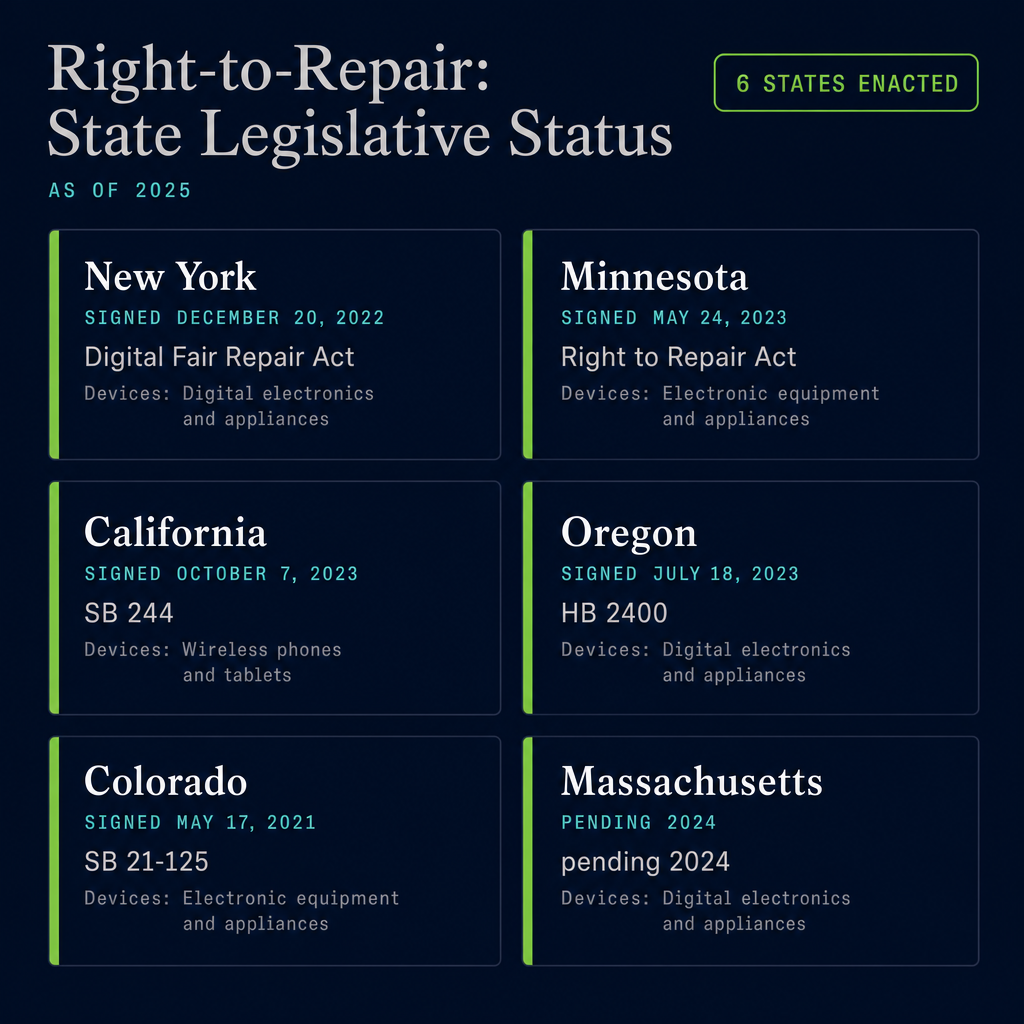
New York was the first state to enact a consumer electronics right-to-repair law. Governor Kathy Hochul signed the Digital Fair Repair Act (A7006-B / S4104-A) on December 28, 2022. The law took effect December 28, 2023, and applies to digital electronic products first sold or used in New York on or after July 1, 2023. It requires OEMs to provide parts, tools, and documentation to independent repairers and consumers on terms no less favorable than those offered to authorized service providers.
Three additional state laws took effect in 2024. Minnesota’s Digital Fair Repair Act, signed in 2023, became operative July 1, 2024, covering consumer electronics, phones, tablets, laptops, and household appliances sold in the state after July 1, 2021. California’s Right to Repair Act (SB 244) also took effect July 1, 2024; it requires manufacturers to provide repair resources for devices priced at $50 or more, with a seven-year availability window for products above $100 and a three-year window for products priced $50–$99.99.
Oregon enacted the most restrictive law to date. Governor Tina Kotek signed SB 1596 in March 2024; it took effect January 1, 2025. Oregon’s law is the first in the nation to ban “parts pairing”, the practice by which manufacturers use serialized component software to restrict functionality when non-OEM parts are installed. The law prohibits manufacturers from triggering false warnings, pop-ups, or performance degradation to deter legitimate repair. Enforcement begins in 2027.
Colorado Governor Jared Polis signed HB 1121 on May 28, 2024. The Colorado law similarly restricts parts pairing and takes effect January 1, 2026. It covers consumer digital electronic equipment and prohibits manufacturers from using parts-identification software to prevent repair or generate misleading alerts.
| State / Level | Bill | Status | Effective | Key Provision |
|---|---|---|---|---|
| AZ | HB4045 Construction defects; repairs; replacements; reports | PENDING | — | — |
| AZ | SB1206 Storm related insurance claims; adjusters | PENDING | — | — |
| CA | AB1903 Construction defects. | PENDING | — | — |
| CA | AB456 Mobilehome parks: sales or transfers: prospective purchasers of mobilehomes. | PENDING | — | — |
| CA | SB988 California Motor Vehicle Glass Act. | PENDING | — | — |
| California | SB 244 | ENACTED | 2024-07-01 | — |
| Colorado | HB 1011 | PENDING | — | — |
| DC | B26-0765 Restoration of Covenanted Roads and Alleys by the District Government Clarification Emergency Amendment Act of 2026 | PENDING | — | — |
| DC | B26-0766 Restoration of Covenanted Roads and Alleys by the District Government Clarification Temporary Amendment Act of 2026 | PENDING | — | — |
| DE | HB176 An Act To Amend Title 3 Of The Delaware Code Relating To The Delaware Agricultural Equipment Right To Repair Act. | PENDING | — | — |
| DE | HB279 An Act To Amend Title 23 Of The Delaware Code Relating To The Delaware Marine Equipment Right To Repair Act. | PENDING | — | — |
| Federal | S.3830 | FEDERAL | — | Federal legislation requiring OEM supply of parts and diagnostic software. |
| HI | HB1464 Relating To Automotive Repair. | PENDING | — | — |
| HI | HB2000 Relating To The Right To Repair. | PENDING | — | — |
| HI | SB795 Relating To Automotive Repair. | PENDING | — | — |
| IL | HB1909 AGRICULTURAL EQUIPMENT REPAIR | PENDING | — | — |
| IL | HB2472 INS-COLLISION REPAIR PROCEDURE | PENDING | — | — |
| IL | HB2549 RIGHT TO REPAIR | PENDING | — | — |
| IL | HB3490 WHEELCHAIR RIGHT TO REPAIR | PENDING | — | — |
| IL | HB4373 INS-MOTOR VEHICLE GLASS ACT | PENDING | — | — |
| IL | SB0122 RIGHT TO REPAIR | PENDING | — | — |
| KS | HB2700 Establishing the Kansas digital right-to-repair act to provide the right for persons who purchase digital electronic equ | PENDING | — | — |
| KS | SB439 Enacting the utility railroad crossing act and establishing a process and limitations for utilities to interact with rai | PENDING | — | — |
| MA | H452 Relative to the right to repair for agricultural equipment | PENDING | — | — |
| MD | HB1429 Consumer Protection - Right to Repair - Motor Vehicles and Farm Equipment | PENDING | — | — |
| ME | LD1228 An Act to Clarify Certain Terms in and to Make Other Changes to the Automotive Right to Repair Laws | PENDING | — | — |
| ME | LD2211 An Act Implementing the Recommendations of the Automotive Right to Repair Working Group | PENDING | — | — |
| MI | HB4549 Occupations: vehicles, dealers, and repair facilities; owner of a motor vehicle repair facility to operate an additional | PENDING | — | — |
| MI | SB0025 Occupations: vehicles, dealers, and repair facilities; owner of a motor vehicle repair facility to operate an additional | PENDING | — | — |
| Minnesota | HF 1512 | ENACTED | 2024-01-01 | — |
| MN | HF1322 Automobile insurance; provisions governing claims handling and settlement offers and agreements modified. | PENDING | — | — |
| MN | HF4835 Tenants provided with a right to repair violations in a residential rental unit, notice required, and tenant permitted t | PENDING | — | — |
| MN | SF2209 Provisions modification governing claims handling and settlement offers and agreements | PENDING | — | — |
| MN | SF4105 Tenants right provision to repair violations in a residential rental unit | PENDING | — | — |
| MO | HB2257 Changes the laws regarding consumer products so that certain individuals and businesses have a right to repair informati | PENDING | — | — |
| MO | HB3384 Creates provisions relating to product repair requirements | PENDING | — | — |
| NC | H460 Medical Equipment Right to Repair Act | PENDING | — | — |
| NC | H938 Right to Repair Digital Electronics Act | PENDING | — | — |
| ND | HB1500 Nonconforming structures in counties, cities, and townships. | PENDING | — | — |
| NE | LB667 Change provisions of the Motor Vehicle Industry Regulation Act | PENDING | — | — |
| New York | A7006-B Digital Fair Repair Act | ENACTED | 2023-07-01 | Manufacturers must provide parts, tools and diagnostics to independent repair shops for devices over $100. |
| NY | A06569 Enacts the "consumer wheelchair repair bill of rights act" requiring manufacturers to make available certain documentati | PENDING | — | — |
| NY | A06601 Requires original manufacturers of agricultural equipment to make certain documentation, parts, and tools required for t | PENDING | — | — |
| NY | S00516 Requires motor vehicle repair shops to disclose whether parts supplied are under warranty and the estimate for all parts | PENDING | — | — |
| NY | S04500 Enacts the "consumer wheelchair repair bill of rights act" requiring manufacturers to make available certain documentati | PENDING | — | — |
| OK | HB3617 Agriculture right to repair; Oklahoma Agriculture Right to Repair Act; equipment and parts; requirements; Attorney Gener | PENDING | — | — |
| OK | SB377 Equipment contracts; modifying definitions; modifying certain prohibited actions; modifying certain consent requirements | PENDING | — | — |
| RI | H7180 Establishes a digital electronics right to repair, which allows for digital electronic equipment and parts that are sold | PENDING | — | — |
| RI | S2487 Establishes a digital electronics right to repair, which allows for digital electronic equipment and parts that are sold | PENDING | — | — |
| US | HB1566 REPAIR Act Right to Equitable and Professional Auto Industry Repair Act | FEDERAL | — | — |
| US | HB5039 Wheelchair Right to Repair Act | FEDERAL | — | — |
| UT | SB0157 New Motorboat Distributor Act | PENDING | — | — |
| VA | HB803 Repairs or maintenance of property; entering adjoining property, petition for entry. | PENDING | — | — |
| VA | SB77 Repairs or maintenance of property; entering adjoining property, petition for entry. | PENDING | — | — |
| WA | HB1483 Revised for 1st substitute: Supporting the servicing and right to repair of certain products with digital electronics in | PENDING | — | — |
| WA | SB5423 Supporting the servicing and right to repair of certain products with digital electronics in a secure and reliable manne | PENDING | — | — |
| WA | SB5680 Establishing a right to repair for mobility equipment for persons with physical disabilities. | PENDING | — | — |
| WA | SB5871 Regulating motor vehicle glass repair claims. | PENDING | — | — |
| WI | SB531 Postloss assignment of rights or benefits under property insurance policies to residential contractors and providing a p | PENDING | — | — |
As of early 2025, iFixit has documented right-to-repair bill introductions in all 50 states over the past eight years. Twenty states had active bills in the 2025 legislative session. For a state-by-state breakdown with bill numbers and status dates, see State Right-to-Repair Bills: Legislative History by State.
The Arguments: Manufacturers vs. Independent Repairers
Manufacturers, represented in federal proceedings primarily by CTIA, the Consumer Technology Association (CTA), and individual company filings, advance four main arguments against broad right-to-repair mandates. First, that sharing repair documentation and diagnostic software creates cybersecurity exposure by giving third parties access to firmware and system-level tools. Second, that parts serialization protects consumers from counterfeit components that could cause device failure or safety hazards. Third, that repair obligations impose compliance costs that reduce investment in new product development. Fourth, that existing warranty programs and OEM-authorized service networks provide adequate repair access.
SecuRepairs, a coalition of cybersecurity and IT professionals, directly contests the first argument. The group argues that independent repair markets reduce attack surface by enabling faster patch deployment and hardware replacement; restricting repair, they contend, concentrates vulnerabilities in authorized service channels rather than dispersing them. SecuRepairs supported Minnesota’s bill and has filed public comments in multiple state proceedings.
Consumer Reports, iFixit, and the U.S. PIRG Education Fund represent the consumer and advocacy side. Their core empirical claim: repair restrictions force premature product replacement, increase per-device costs to consumers, and generate electronic waste. iFixit cites internal repair data showing that the average consumer pays 2–4 times more for OEM-authorized screen repair than an independent shop would charge for the same operation.
Apple presents the most closely watched case. The company launched a Self Service Repair program in 2022 and expanded it to 32 European countries in June 2024, making some OEM tools and parts available directly to consumers. However, parts pairing requirements remain active across iPhone 15 components, and iFixit has documented that Apple’s software verification system reduces functionality when unverified parts are installed, the precise practice Oregon’s law now prohibits for products sold in that state after January 1, 2025. Microsoft’s partnership with iFixit for Surface device repair parts represents a structurally different approach: voluntary parts availability without OEM-controlled software verification gates. For detailed industry lobbying positions, see Tech Industry Opposition to Right-to-Repair: Lobbying and Arguments.
What Counts as “Right to Repair”? Scope Disputes
Legislative drafters face three recurring scope disputes that shape what a law actually covers in practice.
Parts pairing and software locks. Traditional right-to-repair frameworks address parts and documentation availability. Parts pairing adds a second layer: even when physical parts are available, manufacturer-controlled software can disable components or generate false error states when non-OEM parts are installed. Oregon’s SB 1596 is the first U.S. law to directly address this, classifying deceptive parts-pairing alerts as a prohibited unfair trade practice. Colorado’s law follows the same approach. New York’s and California’s laws are silent on software verification gates, a gap that critics argue manufacturers have exploited.
Cybersecurity exemptions. Minnesota’s law includes an exemption for “parts, documentation, or tools related to cybersecurity” that “could reasonably be used to compromise cybersecurity equipment.” The scope of that carve-out is disputed. SecuRepairs has argued the language is overbroad and could allow manufacturers to invoke “cybersecurity” to block access to general repair materials. The Colorado law includes a narrower formulation. How regulators and courts interpret cybersecurity carve-outs will shape enforcement outcomes across the state patchwork.
Product category exclusions. All five enacted state laws exclude some product categories. Common exclusions include motor vehicles (addressed under separate automotive right-to-repair frameworks), medical devices, agricultural equipment (subject to a separate federal regulatory track), and video game consoles. Wheelchair and powered mobility device coverage is addressed in federal legislation introduced in the 119th Congress as the Wheelchair Right to Repair Act (H.R. 5039).
The “independent repairer” definition. State laws diverge on whether consumers have direct rights, whether independent repair shops have separate standing, or whether only OEM-to-independent-repairer obligations exist. New York’s law creates obligations running to both independent repairers and consumers. California’s law similarly covers both. These definitional choices determine who can enforce the statute and in what forum.
What’s Next: Pending Legislation and Regulatory Action
The most active near-term legislative track is state-level. Six additional bills are projected to come into force in 2026, per PIRG tracking. Colorado’s HB 1121 takes effect January 1, 2026. States with bills in active committee in 2025 include Vermont, New Mexico, Wisconsin, Florida, Washington, Texas, Illinois, and New Jersey.
At the federal level, S. 1355 (119th Congress) covers consumer digital electronics but has not received a committee hearing as of May 2025. The automotive REPAIR Act (H.R. 1566 / S. 1379) has bipartisan co-sponsors: Representatives Neal Dunn (R-FL-02), Brendan Boyle (D-PA-02), Warren Davidson (R-OH-08), and Marie Gluesenkamp Perez (D-WA-03) in the House, and has broader industry support from the auto aftermarket sector, which gives it a different political profile than consumer electronics bills.
The FTC’s posture is a watch item. The Commission has not acted on the iFixit-Consumer Reports rulemaking petition filed in 2023. An FTC enforcement wave analogous to the 2022 Harley-Davidson and Weber consent orders, which prohibited conditioning warranties on OEM-authorized service, affecting all five categories of repair restriction documented in the 2021 report. The Commission’s current composition and enforcement priorities under the 119th Congress will determine whether the agency pursues rulemaking or continues the case-by-case warning-letter approach. For enforcement tracking, see FTC Right-to-Repair Report: Enforcement Actions and Rulemaking.
Manufacturers face a compounding compliance problem regardless of federal inaction. The state patchwork (five laws with different scope, different parts-pairing rules, different cybersecurity carve-outs, and staggered effective dates) creates product-line-specific compliance requirements that effectively establish a national floor. A product sold in all five enacted states must meet the most restrictive applicable standard for that product class. Oregon’s parts-pairing ban, which applies to products sold after January 1, 2025, sets the current high-water mark for that specific issue.