WASHINGTON: The Broadband Equity, Access, and Deployment (BEAD) Program distributes $42.45 billion in federal grants to close the U.S. broadband coverage gap. Authorized under Section 60102 of the Infrastructure Investment and Jobs Act (Pub.L. 117-58, codified at 47 U.S.C. § 1702), BEAD is the largest single federal investment in broadband infrastructure to date. As of May 2026, 54 of 56 eligible entities have received NTIA approval of their Final Proposals.
What BEAD Funds and Who Is Eligible
BEAD targets two categories of locations. Unserved locations are broadband-serviceable locations (BSLs) with no access to Reliable Broadband Service at speeds of at least 25 Mbps downstream and 3 Mbps upstream, the minimum statutory threshold established in 47 U.S.C. § 1702(a)(1). Underserved locations are BSLs lacking service at 100 Mbps downstream and 20 Mbps upstream. Unserved areas receive first-priority funding; underserved areas are eligible only after unserved coverage gaps are fully addressed within a given state.
Eligible entities are the 50 states, the District of Columbia, and five U.S. territories: Puerto Rico, the U.S. Virgin Islands, Guam, American Samoa, and the Northern Mariana Islands. Each eligible entity designates a State Broadband Office to administer BEAD funds, conduct the subgrantee selection process, and report to NTIA.
Subgrantees, the ISPs and other providers who receive awards and build the actual infrastructure — must be an internet service provider, local government, electric cooperative, nonprofit organization, or a public-private partnership. Tribal governments may apply as subgrantees. Publicly traded carriers including USTelecom members, NCTA-represented cable operators, WISPA member fixed wireless providers, and NTCA rural telephone cooperatives are all eligible under these criteria.
BEAD does not fund applications already receiving ReConnect, Capital Projects Fund, or other federal broadband subsidies for the same locations. Cost-effectiveness standards apply: subgrantee applications must demonstrate that per-location project costs are reasonable relative to the deployment technology and terrain.
The $42.5B Breakdown: Allocations by State
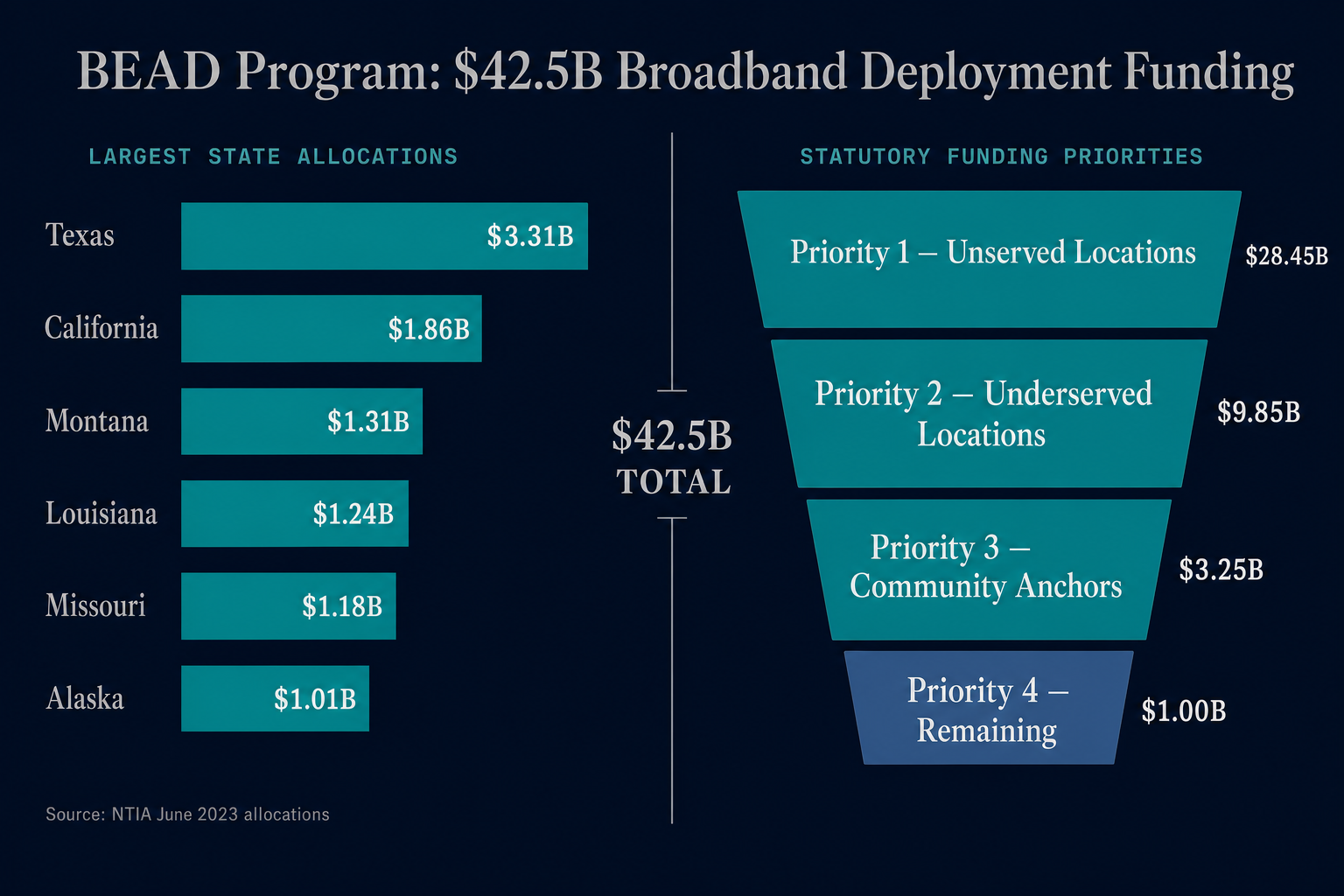
NTIA announced final state allocations on June 26, 2023, using a formula based on the percentage of unserved BSLs in each state relative to total unserved BSLs nationally, as established in the BEAD Notice of Funding Opportunity (NOFO) published May 13, 2022. The allocation methodology draws on the FCC Broadband Data Collection (BDC) maps and the CostQuest Associates Broadband Serviceable Location Fabric as the authoritative count of BSLs.
Each of the 56 eligible entities received a minimum base allocation of $100 million, regardless of size or coverage gap. The remaining funds were distributed proportionally. States with the largest rural and underserved populations, notably Texas, Missouri, and Alabama, received the largest allocations. Nineteen states received more than $1 billion each.
The total program authorization is $42.45 billion. Of that, $100 million is reserved for NTIA administrative costs and technical assistance. The remaining $42.35 billion is available for state distribution.
BEAD Funding Allocation: Top 10 States by Award Amount
| Rank | State / Territory | BEAD Allocation | Primary Driver |
|---|---|---|---|
| 1 | Texas | $3,312,616,455 | Largest unserved BSL count nationally |
| 2 | California | $1,864,136,509 | Large rural footprint despite dense metros |
| 3 | Missouri | $1,736,302,708 | High rural coverage gap relative to population |
| 4 | Michigan | $1,559,362,479 | Significant rural unserved BSL concentration |
| 5 | North Carolina | $1,532,999,481 | Extensive rural unserved geography |
| 6 | Virginia | $1,481,489,573 | Large unserved BSL count in Appalachian southwest |
| 7 | Alabama | $1,401,221,902 | High proportion of unserved rural locations |
| 8 | Louisiana | $1,355,554,553 | Post-storm infrastructure gaps compounded rural deficit |
| 9 | Georgia | $1,307,214,371 | Rural unserved BSL density |
| 10 | Washington | $1,227,742,066 | Eastern Washington rural gaps |
Source: NTIA, June 26, 2023. Allocations based on FCC BDC and CostQuest BSL Fabric data as of the NOFO allocation date. Subsequent challenge processes may have adjusted eligible location counts at the state level.
Technology Priorities: The Original Framework and the 2025 Restructuring
The original 2022 BEAD NOFO established an explicit technology hierarchy. End-to-end fiber deployments were classified as Priority Broadband Projects and received preferential treatment in state scoring rubrics. Non-fiber wired, hybrid fiber-coaxial, and licensed fixed wireless were classified as Other Reliable Broadband Service Projects. Technologies that met the 100/20 Mbps performance standard but lacked the reliability characteristics of wired infrastructure, including unlicensed fixed wireless and low-earth orbit (LEO) satellite — were designated Alternative Technology Projects, eligible only where fiber deployment was cost-prohibitive.
All eligible technologies under the original NOFO had to satisfy a common performance floor: minimum 100 Mbps downstream and 20 Mbps upstream, latency at or below 100 milliseconds, and demonstrated capacity for scalability. This threshold defines a “priority broadband project” under 47 U.S.C. § 1702(b)(9).
On June 11, 2025, NTIA issued the BEAD Restructuring Policy Notice, eliminating the fiber preference and adopting a technology-neutral framework. The Policy Notice directs states to rescind all provisional subgrantee awards and conduct a new “Benefit of the Bargain” application round open to all technology types on equal footing. States had until September 4, 2025 to complete revised Final Proposals. The 100/20 Mbps floor, the 100 ms latency cap, and the scalability requirement remain in force as statutory mandates.
The restructuring also stripped non-deployment uses from BEAD eligibility. Workforce development, digital literacy programs, and community outreach, previously reimbursable under the NOFO, are no longer covered. The Commerce Department cited cost discipline and deployment speed as the rationale. Industry groups including WISPA and USTelecom had lobbied for technology neutrality; consumer advocates and NTCA members representing rural cooperatives raised concerns about lower-cost providers displacing fiber-focused rural carriers.
The BEAD Timeline: Application Deadlines and Deployment Milestones
The BEAD program has moved through five administrative phases since the NOFO publication in May 2022. The program’s statutory structure requires sequential approval gating: NTIA approves Initial Proposals before states proceed to Final Proposals; NIST reviews cybersecurity compliance before grant agreements execute.
Key milestones:
- May 13, 2022: NTIA publishes BEAD NOFO.
- June 26, 2023: NTIA announces state and territory allocations for all 56 eligible entities.
- FY2023–2024: States submit and revise Initial Proposals; NTIA conducts rolling approval reviews.
- Early 2025: NTIA approves 26 state Final Proposals as of February 2, 2025; total reaches 50 of 56 by February 9, 2025.
- June 11, 2025: NTIA issues Restructuring Policy Notice; fiber preference eliminated, Benefit of the Bargain round mandated.
- September 4, 2025: Deadline for all states to submit revised Final Proposals reflecting restructured requirements.
- Late 2025: NTIA review of restructured Final Proposals; 90-day turnaround target.
- Q1 2026: Grant agreements anticipated for compliant states.
- Spring 2026: Construction anticipated to begin in leading states.
As of May 2026, 54 of 56 eligible entities have received Final Proposal approval from NTIA; 52 have cleared NIST cybersecurity review, making grant funds executable. Construction has begun in a small number of jurisdictions that completed the full approval chain ahead of the restructuring.
ISP Concerns: Build-Out Requirements and Affordability Mandates
Industry response to BEAD has split along technology and business-model lines. NTCA: The Rural Broadband Association, representing fiber-deploying rural cooperatives, opposed the technology-neutral restructuring, arguing that the Benefit of the Bargain round creates price competition that undercuts fiber economics without guaranteeing equivalent long-term service quality. WISPA, representing fixed wireless providers, supported the change, noting that licensed fixed wireless can often deliver 100/20 Mbps at lower per-location cost in low-density terrain.
Build-out obligations are defined at the subgrantee level in state plans. The BEAD NOFO requires that subgrantees complete deployment within four years of grant agreement execution. States may impose stricter milestones. Failure to meet deployment benchmarks triggers clawback provisions.
The Low-Cost Broadband Service Option (LCBSO) requirement has been a recurring point of contention. The original NOFO required subgrantees to offer a discounted service tier. The June 2025 restructuring eliminated NTIA’s model LCBSO, which had specified maximum monthly rate caps, and prohibited states from setting explicit rate floors. Subgrantees must now self-propose their own low-cost tier; states retain limited authority to evaluate whether proposed tiers reflect local economic conditions. Consumer advocates including the Benton Institute flagged that without rate guidance, LCBSO commitments in high-cost rural areas may be insufficient for low-income households.
Labor standards requirements were also trimmed in the restructuring. Under the original NOFO, states scored applications on fair labor practices, workforce development, and equity commitments. Those criteria are removed. Subgrantees must now self-certify compliance with federal labor and employment law: a baseline that falls short of the prevailing-wage and workforce-training expectations some state broadband offices had built into their Initial Proposals.
What’s Next: Final Proposals, Benefit of the Bargain, and Awards
The immediate pipeline runs through revised Final Proposal approvals and grant agreement execution. States that completed the Benefit of the Bargain round by the September 4, 2025 deadline and received NTIA and NIST sign-off are positioned to execute grant agreements and begin issuing subgrant awards in 2026. States that requested extensions or required additional NTIA review face delayed award timelines.
The challenge process: a formal mechanism allowing local governments, nonprofit organizations, and competing ISPs to dispute the coverage status of individual BSLs — concluded its primary phase in most states by late 2024. The process drew on FCC BDC map data and CostQuest BSL Fabric version 4.0. Sustained challenges resulted in reclassification of locations from served to unserved or underserved, expanding BEAD-eligible location counts in affected states. The June 2025 restructuring directed states to update their eligible location lists as part of the Benefit of the Bargain revision, incorporating any map corrections issued by FCC or NTIA after the original NOFO allocation date.
Congressional scrutiny remains active. The Congressional Research Service published an analysis of BEAD issues for the 119th Congress (R48666) examining whether the restructured program preserves adequate oversight of subgrantee performance. Appropriations discussions for FY2027 include proposals to accelerate NTIA review timelines and add penalties for states that fail to execute grant agreements within 18 months of Final Proposal approval.
For ISPs participating in state subgrantee selection rounds, the practical near-term calendar is set by individual state broadband offices. Award announcements, required public comment periods on subgrantee selections, and construction commencement deadlines vary by jurisdiction. NTIA’s BEAD Progress Dashboard tracks approval status at the state level on a rolling basis.